


Page 38 - Plastics News December 2025
P. 38
FEATURE NEWS


          building phases. This echoes observations from         improvement budget to ‘smart’ manufacturing
          the American Supply Association (ASA) 2, which         technologies, with a focus on skills training and
          reports that despite 93% of US manufactur-             cybersecurity.
          ers having adopted or experimented with AI in
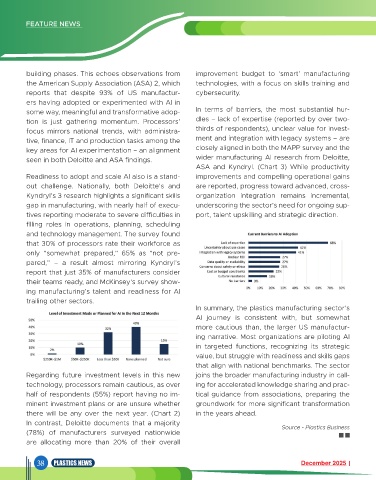
          some way, meaningful and transformative adop-          In terms of barriers, the most substantial hur-
          tion is just gathering momentum. Processors’           dles – lack of expertise (reported by over two-
          focus mirrors national trends, with administra-        thirds of respondents), unclear value for invest-
          tive, finance, IT and production tasks among the       ment and integration with legacy systems – are
          key areas for AI experimentation – an alignment        closely aligned in both the MAPP survey and the
          seen in both Deloitte and ASA findings.                wider manufacturing AI research from Deloitte,
                                                                 ASA and Kyndryl. (Chart 3) While productivity
          Readiness to adopt and scale AI also is a stand-       improvements and compelling operational gains
          out challenge. Nationally, both Deloitte’s and         are reported, progress toward advanced, cross-
          Kyndryl’s 3 research highlights a significant skills   organization integration remains incremental,
          gap in manufacturing, with nearly half of execu-       underscoring the sector’s need for ongoing sup-
          tives reporting moderate to severe difficulties in     port, talent upskilling and strategic direction.
          filling  roles  in operations,  planning,  scheduling
          and technology management. The survey found
          that 30% of processors rate their workforce as
          only “somewhat prepared,” 65% as “not pre-
          pared,” – a result almost mirroring Kyndryl’s
          report that just 35% of manufacturers consider
          their teams ready, and McKinsey’s survey show-
          ing manufacturing’s talent and readiness for AI
          trailing other sectors.
                                                                 In summary, the plastics manufacturing sector’s
                                                                 AI journey is consistent with, but somewhat
                                                                 more cautious than, the larger US manufactur-
                                                                 ing narrative. Most organizations are piloting AI
                                                                 in targeted functions, recognizing its strategic
                                                                 value, but struggle with readiness and skills gaps
                                                                 that align with national benchmarks. The sector
          Regarding future investment levels in this new         joins the broader manufacturing industry in call-
          technology, processors remain cautious, as over        ing for accelerated knowledge sharing and prac-
          half of respondents (55%) report having no im-         tical guidance from associations, preparing the
          minent investment plans or are unsure whether          groundwork for more significant transformation
          there will be any over the next year. (Chart 2)        in the years ahead.
          In contrast, Deloitte documents that a majority                                   Source - Plastics Business
          (78%) of manufacturers surveyed nationwide
          are allocating more than 20% of their overall


             38   PLASTICS NEWS                                                                    December 2025

