


Page 48 - Plastics News March 2026
P. 48
FEATURE NEWS


          manufacturers design instruments for longer life      designs, and explore formats that improve re-
          or safe reuse.  Others  offer reprocessing  pro-      cyclability without sacrificing sterility. Even sim-
          grams for items that hospitals previously dis-        ple changes—such as thinner films or simpler
          carded after one use.                                 structures—can reduce waste volume and lower
                                                                transport emissions. In 2025, some providers re-
          Pharmaceutical and chemical manufacturers             ported transport-emissions reductions of up to
          also adjust processes to cut energy use, recover      12% after they  reduced  packaging  weight  and
          solvents,  and  reduce  hazardous  waste.  Hospi-     volume.
          tals and suppliers reevaluate cleaning agents,
          disinfectants, and sterilization chemicals to limit   Hospitals reinforce this shift through procure-
          environmental and workplace risk.                     ment. They increasingly favor suppliers that of-
                                                                fer smarter, lower-waste packaging over ven-
          Small changes add up at scale. Industry data          dors that rely on outdated, high-waste designs.
          from  2025  suggested  that  hospitals  running
          comprehensive sustainability programs reduced         Healthcare also uses large volumes of chemicals
          waste-related  expenses  by roughly 10–20%            for medicines, cleaning, and sterilization. Hos-
          within three years.                                   pitals now review chemical choices to improve
                                                                safety and reduce environmental harm. At the
          Packaging and C hemicals Get More Attention
                                                                same time, some systems explore chemical re-
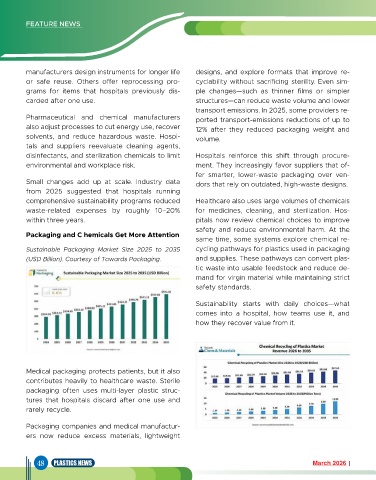
          Sustainable Packaging Market Size 2025 to 2035        cycling pathways for plastics used in packaging
          (USD Billion). Courtesy of Towards Packaging.         and supplies. These pathways can convert plas-
                                                                tic waste into usable feedstock and reduce de-
                                                                mand for virgin material while maintaining strict
                                                                safety standards.

                                                                Sustainability starts with daily choices—what
                                                                comes  into a  hospital,  how  teams  use it,  and
                                                                how they recover value from it.


          Medical packaging protects patients, but it also
          contributes heavily to healthcare waste. Sterile
          packaging often uses multi-layer plastic struc-
          tures that hospitals discard after one use and
          rarely recycle.

          Packaging companies and medical manufactur-
          ers  now  reduce  excess  materials,  lightweight


             48   PLASTICS NEWS                                                                       March 2026

