


Page 29 - Plastics News November 2025
P. 29
ENVIRONMENT NEWS


          hydrometallurgy. Research institutions, including     ensuring that any skill requirements arising from
          IITs and CSIR laboratories, have already devel-       the scheme can be met through collaboration
          oped indigenous processes for metal recovery          between academia and industry.
          and purification. These institutes are also provid-              Source - https://economictimes.indiatimes.com
          ing training in mineral extraction and processing,


          ETH ZURICH AND BASF PIONEER RECYCLING

          OF AUTOMOTIVE SHREDDER RESIDUE AND BIO-WASTE INTO HIGH-VALUE FEEDSTOCK


                                                                The study builds on a gasification pilot project
                                                                conducted  in  mid-2025  by BASF  and  BEST
                                                                GmbH (Austria). For the first time, biomass and
                                                                plastic waste from automotive shredder resi-
                                                                dues were co-gasified in BEST’s pilot plant.

                                                                The process converts biomass and plastic waste
                                                                into steam and synthesis gas, which can be used
                                                                as feedstock for chemical production. This ap-
                                                                proach helps replace fossil raw materials and
                                                                contributes to reducing greenhouse gas emis-
                                                                sions by keeping carbon in circulation.


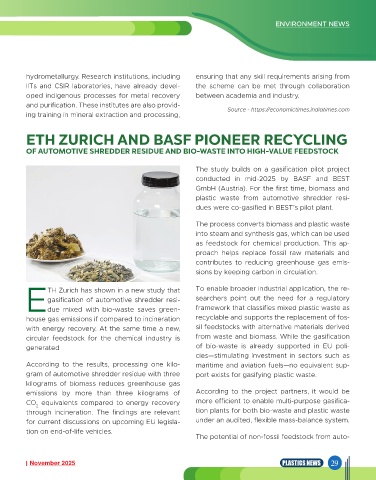
                TH Zurich has shown in a new study that         To enable broader industrial application, the re-
                gasification of automotive shredder resi-       searchers  point  out  the  need  for  a  regulatory
          Edue mixed with bio-waste saves green-                framework that classifies mixed plastic waste as
          house gas emissions if compared to incineration       recyclable and supports the replacement of fos-
          with energy recovery. At the same time a new,         sil feedstocks with alternative materials derived
          circular feedstock for the chemical industry is       from waste and biomass. While the gasification
          generated                                             of  bio-waste  is  already  supported  in  EU  poli-
                                                                cies—stimulating investment in sectors such as
          According  to the  results,  processing  one kilo-    maritime and aviation fuels—no equivalent sup-
          gram of automotive shredder residue with three        port exists for gasifying plastic waste.
          kilograms of biomass reduces greenhouse gas
          emissions by more than three kilograms of             According to the project partners, it would be
          CO  equivalents compared to energy recovery           more efficient to enable multi-purpose gasifica-
             2
          through incineration. The findings are relevant       tion plants for both bio-waste and plastic waste
          for current discussions on upcoming EU legisla-       under an audited, flexible mass-balance system.
          tion on end-of-life vehicles.
                                                                The potential of non-fossil feedstock from auto-


           November 2025                                                                     PLASTICS NEWS  29

