


Page 54 - Plastics News February 2026
P. 54
TECHNOLOGY NEWS


          closed and competitive ecology of industrial          carbon plastics  recycling  technology. Perform-
          plastics.                                             ing performance, compliance, and sustainability
                                                                goals simultaneously, businesses can also meet
          Final Summary for Decision-Makers
                                                                their goals by incorporating bioplastics and re-
          The technology of sustainable plastics is rewrit-     cycling strategies with high-level processing
          ing the history of designing, processing, and         technologies. In the case of B2B stakeholders,
          reusing polymers in industries. New material          forced migration to sustainable plastics is not
          streams are being opened up using advanced            only an environmental issue, but a business case
          recycling  technology, and high-value recycled        of long-term competitiveness.
          plastics  can  be  recycled  to  industry,  and  low-                          Source – Plastics Technology


          THE PRECISION BENEATH THE WATERLINE


                                                                cess that has quietly become the gold standard
                                                                in high-performance polymer processing. At its
                                                                core lies a blend of thermal control, mechanical
                                                                precision, and synchronized motion, all working
                                                                in harmony to deliver pellets that meet the most
                                                                demanding industrial specifications.

                                                                Why Underwater Pelletizing?


                                                                There are conventional pelletizing methods like
                                                                Strand pelletizing where the extruded polymer
                                                                is cooled by drawing it into long strands and ex-
                                                                posing them to open air or a water bath before
                                                                cutting. While straightforward, this method intro-
                                                                duces a sequence of variables that can compro-
                                                                mise consistency: strands may sag, stick, break,
                                                                or be affected by environmental temperature
                                                                and humidity and chances of atmospheric con-
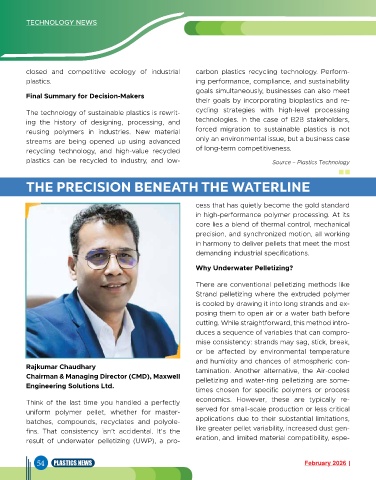
          Rajkumar Chaudhary                                    tamination. Another alternative, the Air-cooled
          Chairman & Managing Director (CMD), Maxwell           pelletizing and water-ring pelletizing are some-
          Engineering Solutions Ltd.
                                                                times chosen for specific polymers or process
          Think of the last time you handled a perfectly        economics. However, these are typically re-
          uniform  polymer  pellet,  whether  for  master-      served for small-scale production or less critical
          batches, compounds, recyclates and polyole-           applications due to their substantial limitations,
          fins. That consistency isn’t accidental. It’s the     like greater pellet variability, increased dust gen-
          result of underwater pelletizing (UWP), a pro-        eration, and limited material compatibility, espe-


             54   PLASTICS NEWS                                                                     February 2026

