


Page 37 - Plastics News November 2025
P. 37
FEATURE NEWS


          CAPTURING CO  WITH RECYCLED HOUSEHOLD PLASTICS
                                     2


                                                                rials make up a sizable portion of real household
                                                                plastic waste.

                                                                Preparing Waste Samples


                                                                In an experiment to assess the effectiveness
                                                                of AC from real household waste, researchers
                                                                sourced common waste materials. Polyethyl-
                                                                ene bags (LDPE), milk containers (HDPE), food
                                                                wrappings (PP), packaging foam (PS), and plas-
                                                                tic bottles comprised the household waste sam-
                                                                ple. Material preparation included dissolving the
                   ixed plastic waste can be transformed        PS foam to remove air bubbles and cutting the
                   into activated carbon through micro-         other plastics into small pieces. The researchers
          Mwave pyrolysis, improving CO  capture                mixed the plastics, then subjected them to high
                                                  2
          and recycling efficiency.                             temperatures in a vertical tubular furnace, pro-
                                                                ducing the char. The researchers used both con-
          Pyrolysis, a process that converts plastics to val-   ventional thermally assisted chemical activation
          uable products, produces a solid char. This char      and microwave-assisted activation to produce
          is a precursor to develop activated carbons (AC),     ACs. Potassium hydroxide (KOH) was the activa-
          which can remove a wide variety of environmen-        tor used in this process.
          tal contaminants. Studies have shown success in
          developing plastic-waste derived ACs from pol-
          yethylene terephthalate (PET) and polystyrene
          (PS). During the recycling of plastics, separation
          and sorting materials is complex and can be ex-
          pensive. Household waste includes many types
          of plastics. Developing porous carbons for CO2
          capture from mixed plastics could make this pro-
          cess more accessible.

          Mixed Waste, Mixed AC Feasibility

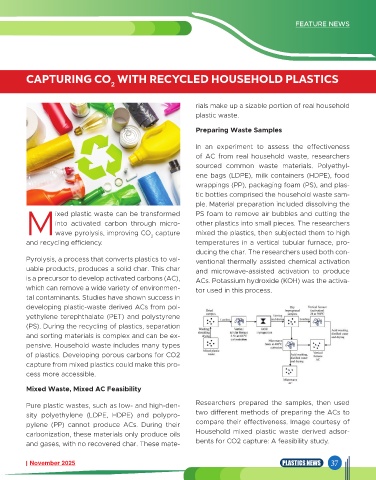
          Pure plastic wastes, such as low- and high-den-       Researchers  prepared  the  samples,  then  used
          sity polyethylene (LDPE, HDPE) and polypro-           two different methods of preparing the ACs to
          pylene (PP) cannot produce ACs. During their          compare their effectiveness. Image courtesy of
          carbonization, these materials only produce oils      Household mixed plastic waste derived adsor-
          and gases, with no recovered char. These mate-        bents for CO2 capture: A feasibility study.


           November 2025                                                                     PLASTICS NEWS  37

