


Page 38 - Plastics News November 2025
P. 38
FEATURE NEWS


          After rigorous testing, both chars performed well,    tivated carbons from mixed household plastics
          but microwave activation required less energy.        at laboratory scale. The results were as follows:
          Microwave activation required a shorter activa-
          tion time and lower activation temperature, and        Activation Method        Cost per Equivalent AC Amount
                                                                 Conventional Activation  £4.85
          thus, required 5x less energy than conventional
                                                                 Microwave Activation     £4.22
          activation. Plotted thermogravimetric curves of
          both chars suggest that the microwave-activat-        While these costs currently exceed the commer-
          ed samples exhibited smaller micropore width.         cial price of activated carbon derived from crop
          Since micropore size highly influences CO2 up-        residues  (£2.25),  the  researchers  attribute  this
          take, this difference in width is significant for ef-  difference primarily to higher electricity costs
          fectiveness.                                          in the United Kingdom. As production scales up
                                                                and energy costs stabilize, the economic gap is
                                                                expected to narrow considerably.

                                                                Toward a Circular and Low-Carbon Future

                                                                This approach demonstrates strong potential
                                                                for commercial-scale application. By integrating
                                                                mixed-plastic recycling with CO  capture tech-
                                                                                                  2
                                                                nology, this process could transform household
                                                                plastic waste into valuable environmental mate-
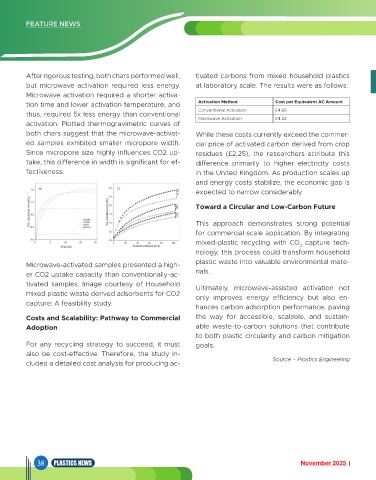
          Microwave-activated samples presented a high-
          er CO2 uptake capacity than conventionally-ac-        rials.
          tivated samples. Image courtesy of Household          Ultimately, microwave-assisted activation not
          mixed plastic waste derived adsorbents for CO2        only improves energy efficiency but also en-
          capture: A feasibility study.
                                                                hances carbon adsorption performance, paving
          Costs and Scalability: Pathway to Commercial          the way for accessible, scalable, and sustain-
          Adoption                                              able waste-to-carbon solutions that contribute
                                                                to both plastic circularity and carbon mitigation
          For any recycling strategy to succeed, it must        goals.
          also be cost-effective. Therefore, the study in-
          cluded a detailed cost analysis for producing ac-                              Source – Plastics Engineering


             38   PLASTICS NEWS                                                                   November 2025

