


Page 68 - Plastics News Issue October 2025
P. 68
PRODUCT NEWS


           food. PLA, however, needs industrial compost-          Market Insights: Growth Drivers and Hurdles
           ing environments to be able to break down, and
           this may cast doubt on its actual environmental        The biodegradable packaging films market in the
           imprint.                                               world is expected to grow tremendously in the
                                                                  next decade. The driving forces are increasing
           PHA Packaging Solutions                                regulations  prohibiting single-use  plastics,  cor-
                                                                  porate sustainability, and increasing consumer
           Polyhydroxyalkanoates (PHAs) are an innova-            awareness.
           tion in PHA packaging and are prepared using
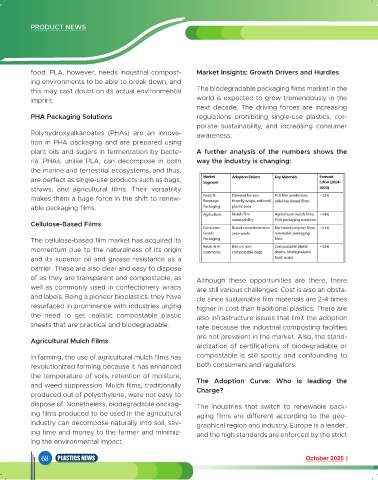
           plant oils and sugars in fermentation by bacte-        A further analysis of the numbers shows the
           ria. PHAs, unlike PLA, can decompose in both           way the industry is changing:
           the marine and terrestrial ecosystems, and thus,
           are perfect as single-use products such as bags,
           straws, and agricultural films. Their versatility
           makes them a huge force in the shift to renew-
           able packaging films.


           Cellulose-Based Films

           The cellulose-based film market has acquired its
           momentum due to the naturalness of its origin
           and its superior oil and grease resistance as a
           barrier. These are also clear and easy to dispose
           of as they are transparent and compostable, as         Although these opportunities are there, there
           well as commonly used in confectionery wraps           are still various challenges. Cost is also an obsta-
           and labels. Being a pioneer bioplastics, they have     cle since sustainable film materials are 2-4 times
           resurfaced in prominence with industries urging        higher in cost than traditional plastics. There are
           the need to get realistic compostable plastic          also infrastructure issues that limit the adoption
           sheets that are practical and biodegradable.           rate because the industrial composting facilities

                                                                  are not prevalent in the market. Also, the stand-
           Agricultural Mulch Films
                                                                  ardization of certifications of biodegradable or
           In farming, the use of agricultural mulch films has    compostable is still spotty and confounding to
           revolutionized farming because it has enhanced         both consumers and regulators.
           the temperature of soils, retention of moisture,
           and weed suppression. Mulch films, traditionally       The Adoption Curve: Who is leading the
           produced out of polyethylene, were not easy to         Charge?
           dispose of. Nonetheless, biodegradable packag-         The industries that switch to renewable pack-
           ing films produced to be used in the agricultural      aging films are different according to the geo-
           industry can decompose naturally into soil, sav-       graphical region and industry. Europe is a leader,
           ing time and money to the farmer and minimiz-          and the high standards are enforced by the strict
           ing the environmental impact.


               68   PLASTICS NEWS                                                                     October 2025

