


Page 25 - Plastics News June 2026
P. 25
INTERVIEW


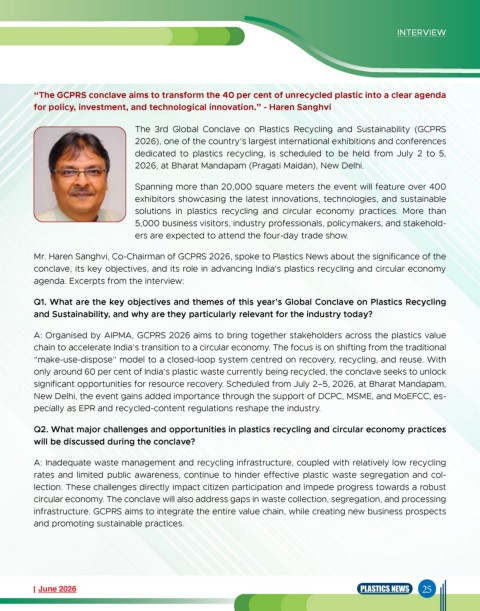
          “The GCPRS conclave aims to transform the 40 per cent of unrecycled plastic into a clear agenda
          for policy, investment, and technological innovation.” - Haren Sanghvi


                                   The 3rd Global Conclave on Plastics Recycling  and Sustainability (GCPRS
                                   2026), one of the country’s largest international exhibitions and conferences
                                   dedicated to plastics recycling, is scheduled to be held from July 2 to 5,
                                   2026, at Bharat Mandapam (Pragati Maidan), New Delhi.


                                   Spanning more than 20,000 square meters the event will feature over 400
                                   exhibitors showcasing the latest innovations, technologies, and sustainable
                                   solutions in plastics recycling and circular economy practices. More than
                                   5,000 business visitors, industry professionals, policymakers, and stakehold-
                                   ers are expected to attend the four-day trade show.


          Mr. Haren Sanghvi, Co-Chairman of GCPRS 2026, spoke to Plastics News about the significance of the
          conclave, its key objectives, and its role in advancing India's plastics recycling and circular economy
          agenda. Excerpts from the interview:

          Q1. What are the key objectives and themes of this year's Global Conclave on Plastics Recycling
          and Sustainability, and why are they particularly relevant for the industry today?

          A: Organised by AIPMA, GCPRS 2026 aims to bring together stakeholders across the plastics value
          chain to accelerate India’s transition to a circular economy. The focus is on shifting from the traditional
          “make-use-dispose” model to a closed-loop system centred on recovery, recycling, and reuse. With
          only around 60 per cent of India’s plastic waste currently being recycled, the conclave seeks to unlock
          significant opportunities for resource recovery. Scheduled from July 2–5, 2026, at Bharat Mandapam,
          New Delhi, the event gains added importance through the support of DCPC, MSME, and MoEFCC, es-
          pecially as EPR and recycled-content regulations reshape the industry.

          Q2. What major challenges and opportunities in plastics recycling and circular economy practices
          will be discussed during the conclave?


          A: Inadequate waste management and recycling infrastructure, coupled with relatively low recycling
          rates and limited public awareness, continue to hinder effective plastic waste segregation and col-
          lection. These challenges directly impact citizen participation and impede progress towards a robust
          circular economy. The conclave will also address gaps in waste collection, segregation, and processing
          infrastructure. GCPRS aims to integrate the entire value chain, while creating new business prospects
          and promoting sustainable practices.


           June 2026                                                                         PLASTICS NEWS  25

