


Page 54 - Plastics News November 2025
P. 54
TECHNOLOGY NEWS


          LASER TEXTURING FOR MOLDS: FROM
          AESTHETICS TO FUNCTION


                                                                Functional Benefits That Reshape Production


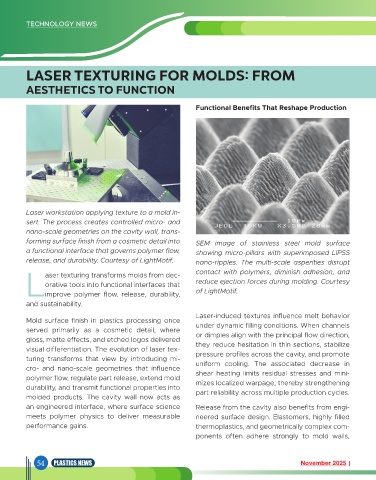
          Laser workstation applying texture to a mold in-
          sert. The process creates controlled micro- and
          nano-scale geometries on the cavity wall, trans-
          forming surface finish from a cosmetic detail into    SEM image of stainless steel mold surface
          a functional interface that governs polymer flow,     showing micro-pillars with superimposed LIPSS
          release, and durability. Courtesy of LightMotif.      nano-ripples. The multi-scale asperities disrupt

                aser texturing transforms molds from dec-       contact with polymers, diminish adhesion, and
                orative tools into functional interfaces that   reduce ejection forces during molding. Courtesy
          Limprove polymer flow, release, durability,           of LightMotif.
          and sustainability.
                                                                Laser-induced textures influence melt behavior
          Mold surface finish in plastics processing once       under dynamic filling conditions. When channels
          served primarily as a cosmetic detail, where
          gloss, matte effects, and etched logos delivered      or dimples align with the principal flow direction,
                                                                they reduce hesitation in thin sections, stabilize
          visual differentiation. The evolution of laser tex-
          turing transforms that view by introducing mi-        pressure profiles across the cavity, and promote
                                                                uniform cooling. The associated decrease in
          cro-  and  nano-scale  geometries  that  influence
          polymer flow, regulate part release, extend mold      shear heating limits residual stresses and mini-
                                                                mizes localized warpage, thereby strengthening
          durability, and transmit functional properties into
          molded products. The cavity wall now acts as          part reliability across multiple production cycles.
          an engineered interface, where surface science        Release from the cavity also benefits from engi-
          meets polymer physics to deliver measurable           neered surface design. Elastomers, highly filled
          performance gains.                                    thermoplastics, and geometrically complex com-
                                                                ponents often adhere strongly to mold walls,


             54   PLASTICS NEWS                                                                   November 2025

