


Page 55 - Plastics News November 2025
P. 55
TECHNOLOGY NEWS


          slowing production and raising the risk of dam-       second systems achieve clean features without
          age. Micro-asperities created by laser pulses         thermal impact, though at higher cost and lower
          disrupt the contact interface, diminish adhesion,     throughput. Engineers balance these trade-offs
          and lower frictional resistance, as demonstrated      to match economic and technical goals.
          by companies such as LightMotif. When com-
          bined with coatings such as diamond-like carbon       Uniformity across complex cavities depends on
          or physical vapor deposition films, textured sur-     beam stability and overlap. Small deviations dis-
          faces further improve cleanliness, shorten cycle      tort patterns and later appear as flaws or weak
          times, and reduce unplanned downtime.                 zones. Designers control depth and aspect ratio
                                                                carefully:  deep  grooves  trap resin  and  compli-
          Durability of molds gains equal importance un-        cate cleaning, while shallow features fade quick-
          der repetitive service. Thermal cycling, abrasive     ly or vanish under coatings.
          fillers, and aggressive cleaning agents degrade
          smooth surfaces rapidly. Textured geometries          Material response further defines limits. Hard-
          distribute stresses more evenly, eliminate sharp      ened steels risk micro-cracking under steep gra-
          transitions, and retain protective residues that      dients, and copper alloys reflect energy unless
          mitigate wear. Ultrafast pulses generate fea-         wavelength and pulse control are precise. Post-
          tures without heat-affected zones, preserving         processing steps such as polishing or thermal
          hardness  and  structural  integrity.  Tool  steels,   treatment often restore surface integrity.
          copper alloys, and nickel alloys therefore sustain    Coatings interact closely with geometry. PVD
          longer service intervals when engineers calibrate     or DLC films extend tool life, but sharp grooves
          geometry to the intrinsic properties of each sub-     create stress points that weaken adhesion. Ef-
          strate.                                               fective textures support full coverage without
                                                                sacrificing fidelity.
          The influence of texturing extends beyond the
          mold and into the polymer component itself.           Performance verification closes the cycle. Con-
          Replicated  surface features  define wettability,     focal microscopy and interferometry measure
          optical response, and tactile performance with-       depth, roughness, and periodicity, while simu-
          out the need for secondary treatments. Medical        lation models predict flow and cooling. Regular
          trays benefit from hydrophilic drainage paths,        inspection after refurbishment confirms that tex-
          automotive panels achieve low-glare matte fin-        tures retain function and sustain quality.
          ishes, and packaging lids acquire anti-smudge         Emerging Directions and Trends
          functionality. These properties emerge directly
          from the molding process, reducing cost while
          simplifying downstream recycling.

          Technical Factors That Define Performance

          Laser system selection dictates both precision
          and productivity. Nanosecond sources run faster
          and cost less but leave recast material that de-
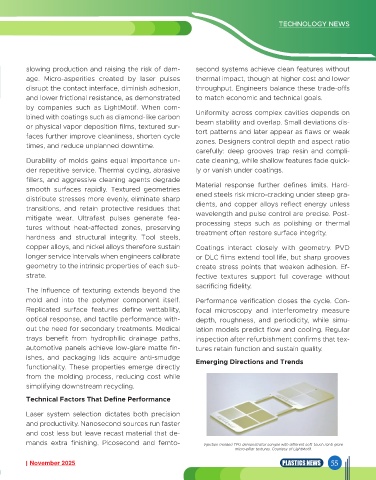
          mands extra finishing. Picosecond and femto-             Injection molded TPU demonstrator sample with different soft-touch /anti-glare
                                                                             micro-pillar textures. Courtesy of LightMotif.

           November 2025                                                                     PLASTICS NEWS  55

